

Rubbish removal in Shoreditch
Our Shoreditch service removes household furniture and business rubbish, with carrying and loading for the agreed contents. We cover all London and the M25, offer same-day service and take calls 24/7. Domestic and commercial loads receive the appropriate assessment and quotation.
Estimate a Shoreditch household load
Choose the service; business enquiries receive an individual quote.
Can household and business rubbish use the same price guide?
The household guide is not a commercial tariff. We quote separately for business rubbish according to its materials, amount and handling. A home collection may use the published household bands, while office furniture, shop waste or a business clear-out needs its own assessment. The objects alone do not establish whether the waste is domestic or commercial.
What local distinction matters for a Shoreditch collection?
For addresses within Hackney, the council separates household bulky collection from business, landlord and tradesperson waste. Its commercial arrangements also distinguish different waste streams. Our private collection is assessed separately, with the origin and material of the load identified. The full address should establish the relevant council rather than relying on the neighbourhood name alone.
Tom’s Junk Collectors provides home and business rubbish removal in Shoreditch. We collect agreed furniture, appliances, household contents and commercial rubbish, carrying it from the identified rooms or working areas. Domestic belongings and business items are identified separately within a mixed-building enquiry, with a suitable quotation for each collection requirement.
The local information here uses Hackney Council guidance for addresses in its borough. It makes a practical distinction between a private clear-out, the council household bulky route and a business’s regular waste arrangements.
- Household furniture assessed as a domestic removal when appropriate.
- Office and shop contents quoted for the business job.
- Electrical equipment listed separately within a clear-out.
- Property access assessed around the building entrance and carrying route.
Domestic removal with a defined household load
Our household collections remove unwanted seating, storage furniture, beds and smaller belongings from the property. We can take selected items. Bags and boxes accompanying a larger piece are included when identified in the collection description, so the quote reflects more than the headline furniture item.
The team carries the agreed contents from their location to the vehicle. Volume and weight are both relevant to the larger household bands. A stack of light packaging occupies space differently from compact boxes of books, even when the two groups appear similar in a photograph.

| Enquiry | Local context | How our quote treats the job |
|---|---|---|
| Resident replacing furniture | Hackney’s household bulky service is distinct from its commercial service. The relevant council depends on the full address. | Our domestic enquiry identifies the furniture, associated household belongings and actual carrying route. A property name or neighbourhood label is not a substitute for an address and an item description. |
| Business changing its workspace | Hackney directs businesses to commercial collection arrangements, rather than free household waste collections. | We quote for the unwanted desks, chairs, packaging or other agreed business contents. The household minimum and volume bands do not establish a commercial price, even for a small-looking office load. |
| Landlord or tradesperson clearance | Hackney’s bulky guidance directs landlords and tradespeople towards the commercial route rather than its household bulky booking. | The enquiry identifies who generated the rubbish and what it contains. Furnishings and renovation materials are separated in the description so the appropriate collection can be assessed. |
| Waste from more than one activity | Hackney’s commercial guidance distinguishes rubbish, recycling and food waste arrangements. | Our clear-out description identifies the different material groups being removed. The quotation covers the specified furniture and rubbish, while the business can keep its routine bin and other waste arrangements separate. |

Business clear-outs quoted separately
We remove unwanted desks, chairs, shelving, packaging and other agreed business rubbish from offices and retail premises. The enquiry identifies what leaves and what remains in use. A business collection receives its own quotation rather than being assigned a household allowance because some items resemble domestic furniture.
For a workplace change, the job can cover furniture and associated contents across the agreed work area. Electrical equipment remains recognisable in the inventory. Owners arrange any information-protection work before computers or confidential papers are handed over.
| Domestic allowance | Published guide | Interpreting a proposed load |
|---|---|---|
| No more than 50kg | £55 | The minimum household guide is weight-limited, with its volume allowance established in the quote. The dimensions of a bulky lightweight item remain relevant to assessing the proposed collection. |
| 3 cubic yards and 250kg maximum | £120 | The larger tier has two limits applying together. Compact heavy contents can use the weight allowance without filling the stated volume, while large light furniture may do the reverse. |
| 6 cubic yards and 500kg maximum | £180 | The guide covers the combined domestic load within both allowances. It is not a fixed price for a flat, a room or an office of a particular size. |
| 9 cubic yards and 760kg maximum | £240 | A larger group of household items is assessed as a whole. Extra bags or furniture alter the description and may move the collection beyond an originally anticipated band. |
| 12 cubic yards and 1,000kg maximum | £305 | Loads above either published allowance need quotation. Commercial jobs, electrical-only collections and whole-property clearances are individually assessed rather than assigned this highest household tier automatically. |
One address can contain different removal requirements
Our assessment distinguishes the origin of the waste as well as where it is stored. Contents removed by a resident, a business clear-out and debris generated by tradespeople need different descriptions. Bringing them into the same enquiry does not make the materials interchangeable or turn commercial rubbish into a household load.
The team works to the agreed collection list and carrying route. Floor level, working lift, shared doors and the position available for loading are considered together, so removal connects the identified rooms with the vehicle.

| Material group | Removal we can assess | Why the description matters |
|---|---|---|
| Domestic seating and storage | Unwanted sofas, tables and freestanding storage furniture can be carried and loaded with listed household contents. | The size of each piece affects vehicle space and the carrying route. A furniture name does not reveal whether it is a small occasional chair or a large heavy item. |
| Office furniture | Desks, chairs and other agreed workplace furnishings form a commercial removal enquiry. | The inventory distinguishes surplus pieces from furniture staying in use. The quote follows the actual business contents and removal work, not the numerical household guide for a similar-looking object. |
| Computers and accessories | Identified electrical equipment can be described alongside a business or household clear-out. | Equipment type, quantity and dimensions distinguish a few accessories from a larger group of monitors or computers. Owners complete any personal-information preparation separately before the agreed devices are carried away. |
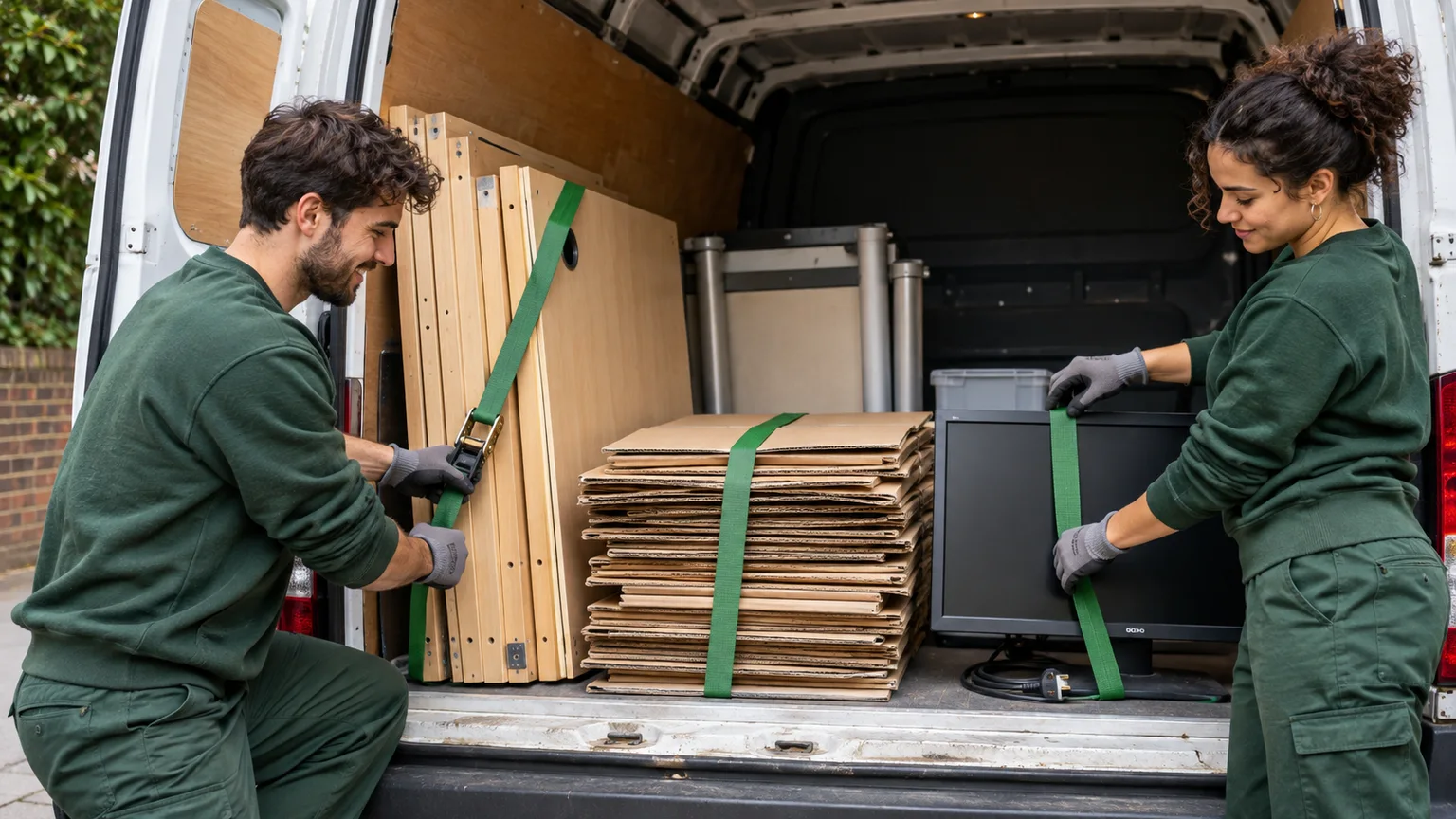
Material handling after a mixed clear-out
We take the collected rubbish away for responsible handling, recycling as much as possible. Wood, metal, textiles, packaging and electrical equipment may require different onward routes. The collection description keeps those groups identifiable, especially when furniture and smaller equipment are being removed together.
Hackney publishes business waste responsibilities and collection arrangements. Our one-off clear-out is quoted for the actual removal, separately from routine business bin services.
| Collection detail | What our assessment considers | Practical result |
|---|---|---|
| Items on several floors | The location of the agreed furniture and the available stairs or working lift connect each work area to the exit. | The removal covers carrying from the identified rooms or storage areas. The route from each collection point to the vehicle matters even when the load is small or the entrance is at ground level. |
| Shared entrances | The enquiry explains how the collection team reaches the identified rubbish through the building. | Doors and shared routes form part of arranging the collection. Access details provided by the premises contact connect the agreed removal list with the entrance, internal route and practical vehicle loading point. |
| Requirement | Relevant context | Clear-out arrangement |
|---|---|---|
| Identify the agreed rubbish | Hackney’s business guidance emphasises arrangements for business waste and preventing its escape. | Our collection list defines the unwanted contents leaving the premises. It keeps retained stock, active equipment and unrelated waste distinct, allowing the removal to address the actual request rather than an undefined working area. |
| Confirm the material breakdown | A workplace may contain furniture, packaging and electrical equipment together. | The quotation reflects those material groups and their quantities. It establishes the proposed removal without borrowing a household tariff or promising that every substance encountered will be accepted as ordinary business rubbish. |
| Discuss required paperwork | Hackney advises businesses to retain evidence of their waste disposal arrangements. | Collection documentation requirements can be included in the business enquiry alongside the materials and carrying work. Available records are confirmed with the quotation so the business can assess the proposed collection arrangement. |
Collections in Shoreditch
We cover Shoreditch and all London and the M25. Our 24/7 call line accepts collection enquiries at any hour. Same-day service is available; the collection time is confirmed for the actual job and schedule.
Local council collection and recycling information
Frequently asked questions
Can a small office use the £55 household minimum?
The household minimum is not a confirmed office tariff. An office enquiry receives a commercial quote for the contents and carrying work, whether the business occupies one room or a larger premises.
Can you quote for a resident and a business in the same building?
The enquiry can identify both requirements. Domestic belongings and business rubbish should be described separately so the origin, materials and appropriate quotation for each are clear.
How is loading arranged for a Shoreditch collection?
The vehicle loading point and carrying route form part of the collection assessment. Shared entrances, floor level and the position available for loading are considered alongside the items being removed, so the arrangement reflects the premises.
Does collecting an old computer include erasing its data?
Owners complete their information-protection work before handing over computers or storage devices. The collection list identifies the equipment for physical removal; any specialist data-erasure work is arranged separately.
Will you replace my routine business bin service?
Our one-off clear-out removes the agreed items from the premises. Routine bins and continuing waste collections remain separate services, so the business can arrange a furniture or equipment clear-out alongside its everyday waste arrangements.